
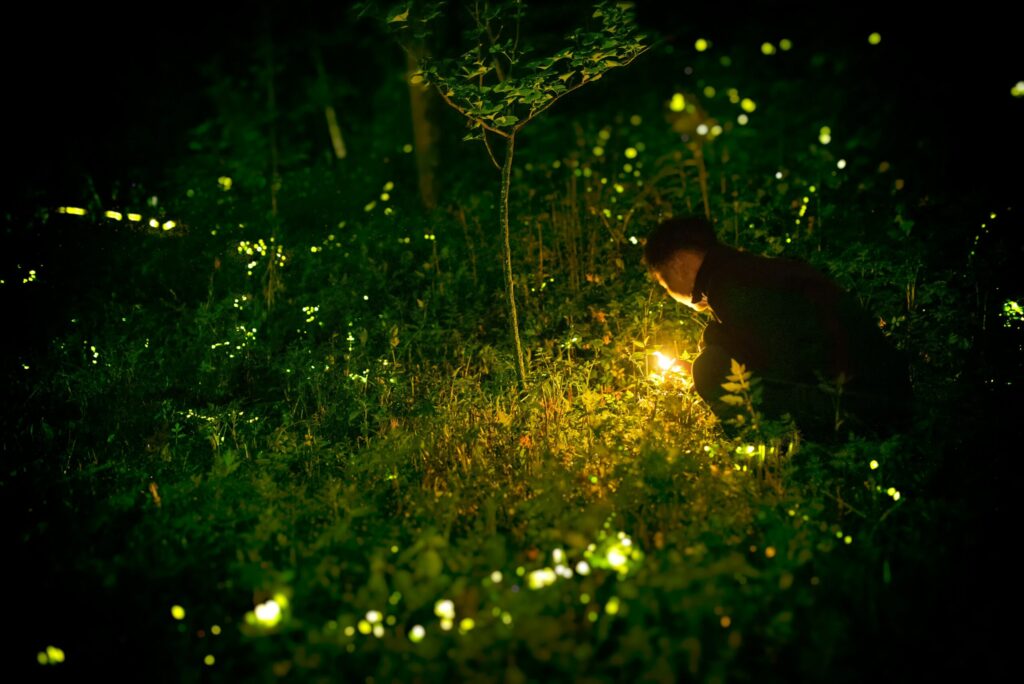
When I was a kid, summer nights only began when the dim glow of fireflies lit up the backyard. I’d watch as their light blinked for a split second before fading again. For years, I’d scoop a few into a jar and let them go without a second thought to their tiny sparks. Then one day I asked myself, why do fireflies have blinking butts?
This natural glow is called bioluminescence. It’s one of evolution’s most fascinating inventions, but why do some animals glow while others are left relying on the sun for light? How did animals develop the ability to glow in such different environments?
From coral reefs to forest floors, let’s explore the science behind the evolutionary pressures that helped shape nature’s light show.
What Is Bioluminescence?
Bioluminescence is the ability of a living organism to produce light through a chemical reaction.1
The chemical reaction usually involves three things: luciferin, luciferase, and oxygen.
Now, I’m sure you’ve heard of oxygen – it’s in the air you breathe every day. But what about luciferin and luciferase? Unless you’re well-versed in biochemistry, it’s unlikely that you’ve heard of these.
Let’s take a look at what these chemicals are.
Luciferin is a molecule that produces light when it interacts with oxygen. Luciferase is an enzyme that speeds up this reaction.
You might wonder, why is luciferase needed in the reaction if the glow itself is already produced by the luciferin?
Well, this is because the reaction between oxygen and luciferin is so slow that we wouldn’t see the “blink” without luciferase speeding up the reaction.
When these three ingredients combine, the organism emits light — often blue or green in water, and green or yellow on land.
Keep in mind that bioluminescence is different from fluorescence or pigments that glow in the dark. These two things require an external source, like UV light, to “charge” the glow. Once that external source is removed, the glow disappears along with it.
Bioluminescent animals make their own light – without external sources.
Where Do Glowing Animals Live?
Bioluminescence is found in both aquatic and terrestrial environments, though you’re more likely to find it in the ocean.
Here’s a chart of bioluminescent animals you’d find in the ocean versus on land.
| Ocean | Land |
| Jellyfish | Fireflies |
| Anglerfish | Glow-worms |
| Shrimp | Certain millipedes and beetles |
| Dinoflagellates (plankton) | Some snail species |
| Squid | Bioluminescent fungi (foxfire) |
The glow developed by these animals evolved independently in different environments, shaped by unique challenges and opportunities.
How Did Bioluminescence Evolve?
Throughout the span of Earth’s history, bioluminescence has evolved at least 40 times. Glowing was so useful that it was reinvented in three evolutionary pathways: self-made light, symbiotic light, and diet-based light.
Self-made light is what we previously discussed. These animals use a chemical reaction between oxygen, luciferin, and luciferase to create light. Examples include fireflies, certain types of jellyfish, and deep-sea shrimp.
Symbiotic light is created when animals host glowing bacteria. This means that the bacteria live in or on the body of the animal.
A symbiotic relationship is mutually beneficial. The animal provides a home for the bacteria while the bacteria provide light for purposes such as camouflage, communication, or hunting. Examples of this include anglerfish and the Hawaiian bobtail squid.
Lastly, we have diet-based light. These animals glow because they eat other glowing organisms. The animals they eat continue to give off light for a short period of time, or they “steal” luciferin from their prey to create their glow. Examples include some sea slugs and fish.
Why Did Animals Evolve Glow?
Species glow for different reasons. In this next section, we’ll provide examples of five different ways that animals use bioluminescence as a survival advantage, both in the ocean and on land.
1. Camouflage: Hiding with Light
In the ocean, animals like lanternfish use something called counter-illumination. This is when they produce a glow on their bellies to match light from above, making them nearly invisible to predators below.
On land, camouflage glowing is rare, but bioluminescent firefly larvae live on glowing fungi. Their glow allows them to blend in with the fungal mat to avoid becoming a tasty snack.
2. Hunting: Fooling Their Food
Unlike using bioluminescence for camouflage, some animals use it to attract their prey. Anglerfish use glowing lures to attract prey, kind of like a fishing hook. There are also some jellyfish that glow to draw prey into their tentacles.
Bioluminescent hunting is rare for land animals, but there is one fascinating exception – glow-worms.
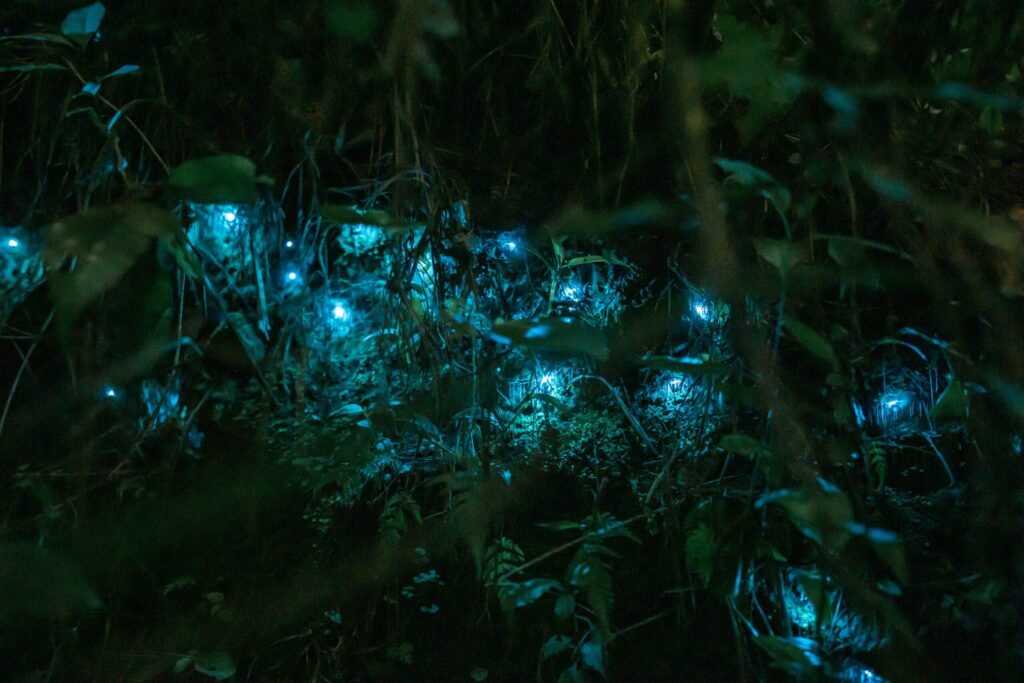
Glow-worms hang sticky silk threads from cave ceilings and use the blue-green light from their butt to illuminate the thread. The light mimics natural cave openings illuminated by moonlight, tricking insects into flying straight into the sticky threads.
3. Defense: Surviving with Light
When chased by predators, deep-sea sea slugs drop glowing body parts as decoys. This process is called autotomy. While the predator goes after the decoys, the slug swims off to safety.
There aren’t any land animals that drop glowing body parts, but have you heard of poisonous dart frogs? These frogs display a bright color to warn predators that they are toxic, and to avoid eating them.
Like the frogs, there are about a dozen millipedes that are toxic. They have a cyanide-based toxin that is harmful to ingest. To alert predators of their toxicity, they emit a continuous green-blue glow beneath their exoskeleton.
4. Reproduction: Finding the Right Partner
We’ve mentioned fireflies plenty of times now, so you’d think we touched on all the ways they use bioluminescence, but there’s more. Fireflies also use their light for courtship. Each species has a unique flashing code, and the females only respond to the correct pattern to mate.
Courtship for fireflies seems simple enough, but it can become deadly. There are some fireflies that are known to mimic the code of other fireflies to lure them in and eat them!
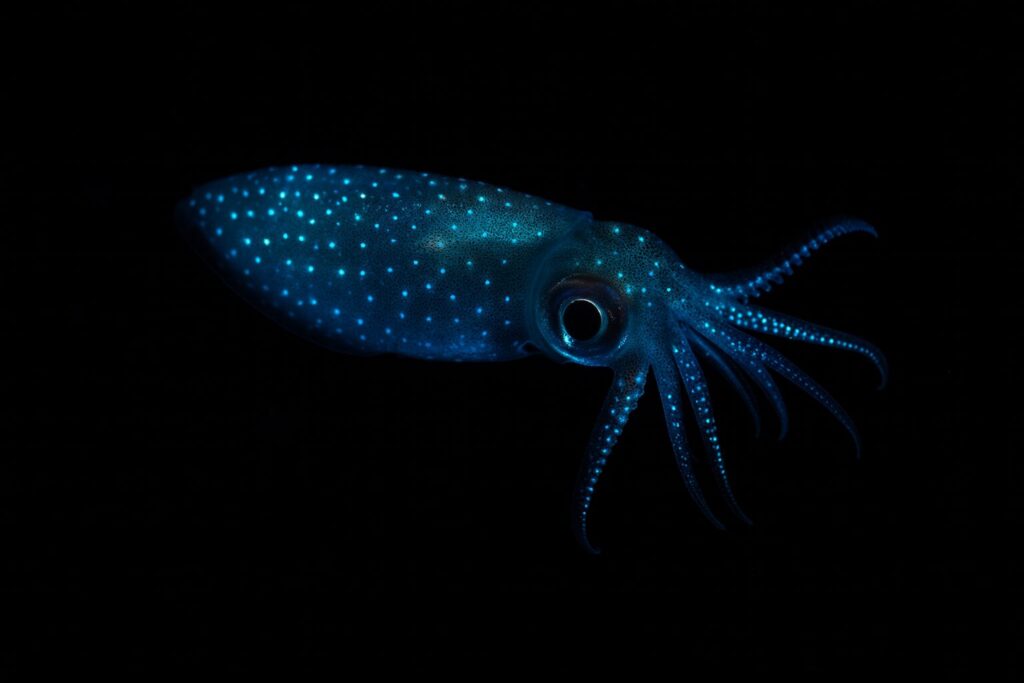
Similarly named, firefly squid also uses bioluminescence for mating rituals. Males emit vivid blue flashes to let nearby females know they’re present and ready to mate. This leads to large groups of firefly squid all gathering in what is called a mass spawning event.
5. Communication: Talking with Light
The next use is for communication. Flashlight fish will use a glow just beneath their eyes to signal movement to other flashlight fish. This helps them stay together is a school even in complete darkness.
Like stated previously, fireflies use their light for reproduction. Reproductive light signals are a type of communication. Fireflies can’t use words, so they use their bioluminescence to talk to each other instead.
In its own way, light is communication.
Why the Ocean Creates More Bioluminescence
By now, you may have noticed that there are significantly more ocean animals that have bioluminescence than land animals.
In fact, 76 percent of ocean animals have some level of bioluminescence! There are several reasons as to why it is far more commonly found in marine environments.
The deep sea is completely dark because the sun’s rays can’t penetrate that deeply into the water. Making light is extremely useful for an environment that does not have natural lighting.
Additionally, water transmits blue and green light efficiently, allowing these wavelengths to travel much farther than other colors.
Other colors, such as red and orange, are absorbed quickly by the surrounding water, so the wavelengths don’t travel as far.
As a result of evolution, bioluminescence favored blue-green colors instead of red-orange colors for an animal to be visible from long distances.
What Does Bioluminescence Teach Us About Evolution?
Bioluminescence is evolution in action. It shows how traits can appear randomly through mutation but continue to spread because they help with survival.
Unconventional glowing strategies evolved independently to work well in unique environments. Though the glow between different animals may be similar, they have distinct differences to enhance their effectiveness.
From fireflies to fish in the deep sea, bioluminescence is essential for communication, survival, and reproduction.
The next time I see fireflies lighting up my backyard, I’ll see more than just a simple glow. I’ll watch these tiny creatures communicating and using light to survive the night. Until then…
Hands-on Activity, Definition Sheet, and Printable Article
Glowstick Lab Activity
Student Lab Worksheet
Definition Sheet
Printable Article
Sources
- Tsarkova, A. S. (2021). Luciferins under construction: A review of known biosynthetic pathways. Frontiers in Ecology and Evolution, 9.
- He, J., Li, J., Zhang, R., Dong, Z., Liu, G., Chang, Z., … Liu, H. (2024). Multiple origins of bioluminescence in beetles and evolution of luciferase function. Molecular Biology and Evolution, 41(1).
- Viviani, V. R. (2023). Looking into luciferin. Nature Chemistry, 15(10), 1001–1002.
- Haddock, S. H. D., Moline, M. A., & Case, J. F. (2017). Bioluminescence in the sea. Annual Review of Marine Science, 9, 293–322.
- Widder, E. A. (2010). Bioluminescence in the ocean: Origins of biological, chemical, and ecological diversity. Science, 328(5979), 704–708.