

Long after most creatures begin to wither, a special few remain eerily unchanged. They don’t have wrinkles, body aches and pains, or a biological clock ticking down in the background.
These animals don’t just outlive expectations; they defy the concept of aging altogether. Once believed to be a myth, these biologically bizarre animals have already mastered the secret to life.
Today, we’re jumping straight into one of the strangest corners of biology — animals that don’t age like we do.
Some of them regenerate endlessly. Others reset their life cycle like hitting “restart” in a video game. And some simply… don’t deteriorate.
These creatures challenge us to question what we believe we know about life, aging, and what it means to grow old.
Come with me to hear the whispers of the animals that seem to have told aging, “No, thanks.”
A World Where Aging Isn’t Guaranteed
When we’re young, we tend to see people that life has blessed with wrinkles and think, That won’t be me when I’m older.
Let’s face the truth here. Nobody can avoid wrinkles from years of smiling.
But nature can.
Scientists have discovered animals that show negligible senescence.1 This means that the animals don’t show typical signs of aging like wrinkles, decreased bone density, or slower brain activity.
A select few animals even appear to be biologically immortal, meaning that they can theoretically live forever. Now, this doesn’t mean they’re invincible. It just means they don’t age in the typical sense.
Let me introduce you to our wonderful, nearly immortal friends who defy time itself.
The Immortal Jellyfish: Reversing Life
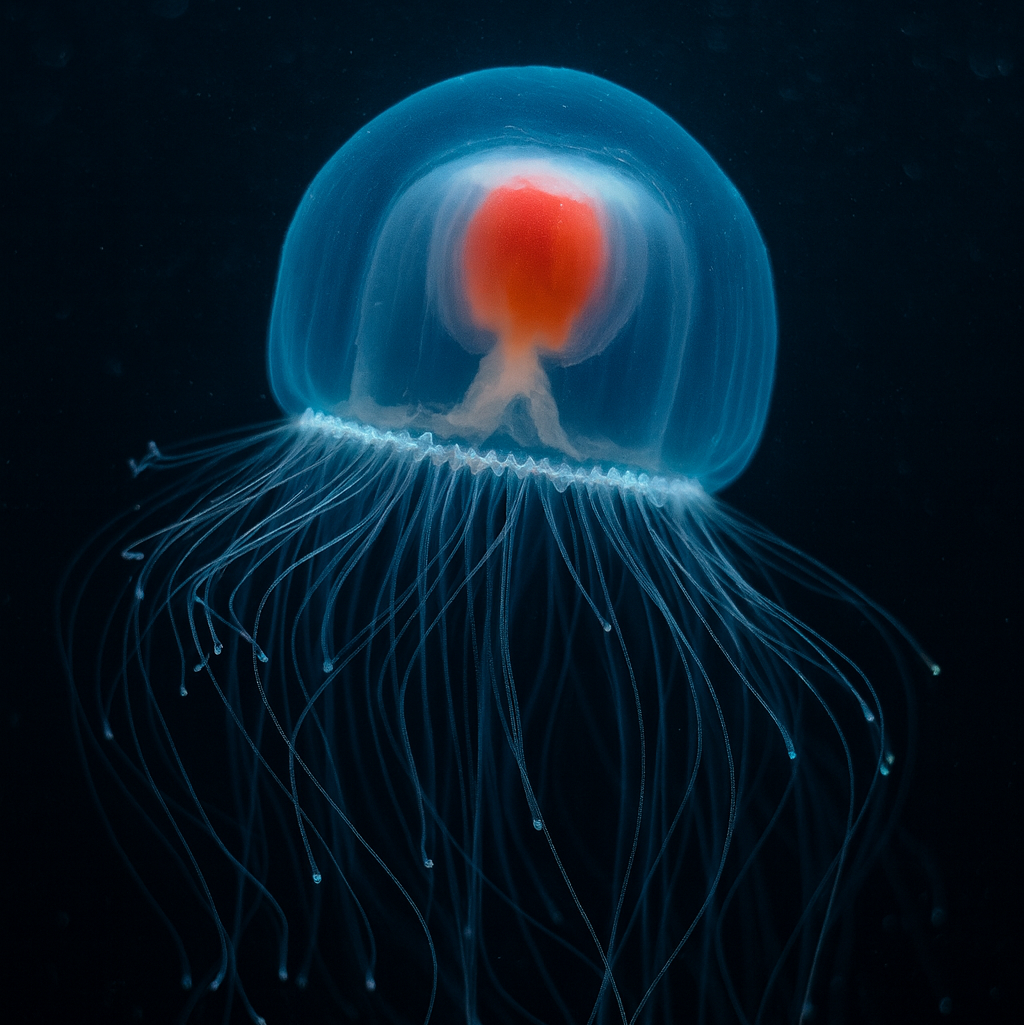
In life, we start in a diaper as a baby, and sometimes we wind up in diapers as adults, but we never become a baby again.
But what if I told you that there is an animal that can reverse time and become a baby again? Would you believe me?
It’s okay. I didn’t believe it at first either, but there is an animal that does this, and it’s called the immortal jellyfish.
When stressed, injured, or aging, this little guy can perform an astonishing trick: it reverses its life cycle. It transforms from a fully grown jellyfish back into a juvenile polyp.2
You can think of this like a butterfly turning back into a caterpillar.
Here’s how it works.
The adult jellyfish cells transform into younger cell types, which revert the jellyfish to its earliest life stage – the polyp – and it begins growing again like nothing ever happened.
This process is called transdifferentiation.2 It’s such a bizarre process that even scientists don’t fully understand how it works, but they’re still just as fascinated by it without that knowledge.
If nothing eats, freezes, or destroys this jellyfish entirely, it could live forever by repeating its life cycle.
Planarian Flatworms: Masters of Regeneration
Immortal jellyfish may be the “restart” button of nature, but planarians are the definition of an “infinite healing” cheat code.
These worms have the ability to regenerate any part of their body thanks to stem cells called neoblasts.3
Neoblasts are stem cells that can turn into almost any type of cell in the body.3 They divide rapidly, becoming whatever the body needs to regenerate, then follow a biological blueprint to reconstruct the planarian.
So, what happens if the worm is cut in half? It becomes two.
Cut it into twenty pieces? You’ll be left with twenty worms!
These stem cells continuously replace old tissues, essentially maintaining youthful function indefinitely.
There is one catch, though. When the worms split during asexual reproduction, each new worm is genetically identical to the original.
Without genetic variation, it is unlikely that planarians will evolve. If a bad parasite, toxin, or environmental change threatens them, the entire species could be at risk.
As of now, scientists still study these tiny worms in hopes of someday finding a way to slow down or reverse human aging.
Naked Mole Rats: The Mammalian Rebels
Now let’s talk about a creature that looks like a wrinkled pink sausage but behaves like a biological superhero.
The naked mole rat is a mammal just like us, but it ages in a completely different way.
Scientists have discovered that naked mole rates have unique adaptations in their DNA that help avoid age-related decline. They can repair breaks in DNA through a process called homologous recombination.4
You can think of homologous recombination as a copy-and-paste repair system. If one part of the DNA breaks, it’s replaced with an undamaged copy.
This copy-and-paste system helps cells resist damage, which is one reason naked mole rats rarely get cancer. Additionally, there is almost no increase in mortality risk as they age.
If people aged like naked mole rats, we’d still look like teenagers until our 80s!
Greenland Sharks: The Longest-Lived Vertebrates
So far, we’ve had animals that can practically live forever, and others that don’t live forever but maintain a youthful appearance. Greenland sharks fall in the middle of these two things.
Outliving every other vertebrate, Greenland sharks flaunt an astonishing 250–500-year lifespan.5 Some of these sharks that are alive today have been swimming through the Arctic waters before the United States was founded.
With an extremely low metabolism shaped by the freezing deep‑sea environment, Greenland sharks grow less than half an inch per year.
Doesn’t that seem like a tiny amount of growth? Well, to people, it is — you grew more than eighteen times that in your very first year as a baby!
The Greenland shark’s low metabolism helps limit cellular damage, allowing them to age at an incredibly slow pace. At the same time, these gentle sharks glide through the water at a slow, steady speed, reducing wear and tear on their bodies.5
Corals: The “Collective Immortals”
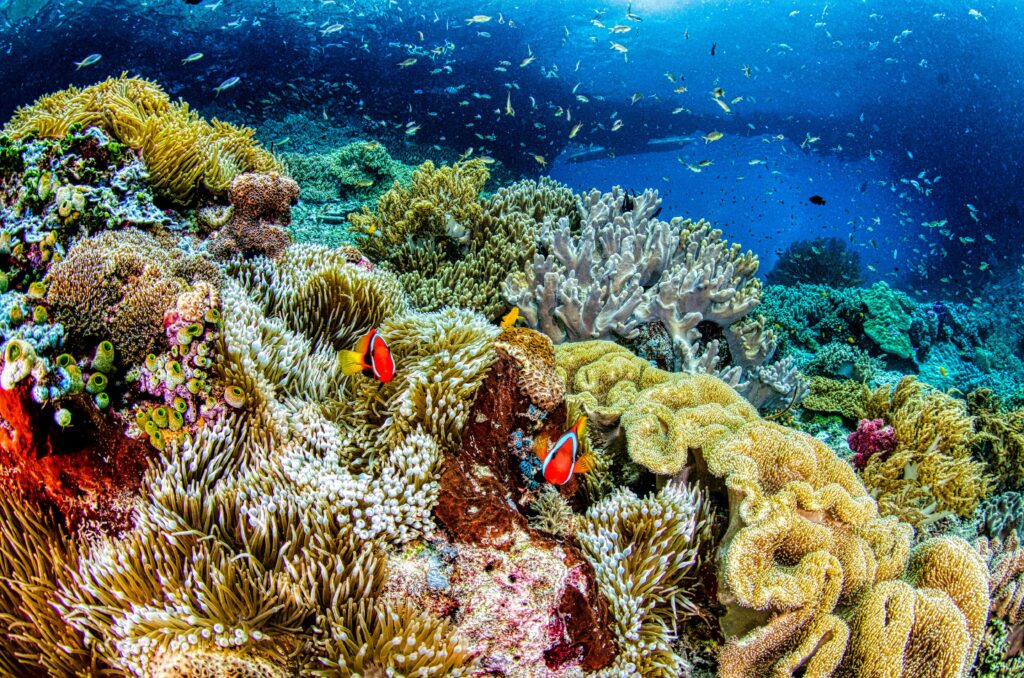
Although immortality may seem like it applies to an individual, some animals achieve it as a colony.
Coral reefs have survived for thousands of years. A single coral doesn’t live that long, but the colony does.
Each colony is made up of tiny polyps, similar to the baby stage of an immortal jellyfish. As the polyps grow, they build a hard calcium-carbonate skeleton beneath themselves.1
When they die, they leave behind the skeleton for new polyps to grow on top of. New layers are added year after year. Over time, this helps form massive reef structures, like the Great Barrier Reef.
How exactly are corals immortal then? Well, it’s because the polyps clone themselves to expand the reef.
They reproduce through a process called budding, where new polyps replace old ones. While a single coral itself may die, the whole coral structure can live indefinitely, as long as conditions are stable.
The Great Barrier Reef is a prime example of this, with an estimated age of anywhere between 6,000 to 10,000 years old!
Unfortunately, harmful factors like environmental changes and human pollution are threatening our coral reefs. Human intervention may be needed to help our reefs survive for the next few thousand years.
A Last Look at Ageless Life
From jellyfish that turn back time to worms that regenerate endlessly, these creatures remind us that aging isn’t a universal rule.
Some animals grow old, others grow ancient, and some don’t seem to age at all. They can still die from things like predators, disease, accidents, and environmental changes. However, they hold invaluable clues to understanding how to increase longevity.
If you ever find yourself staring at a tiny jellyfish drifting through the water or through the glass in an aquarium, you might be looking at a creature that has unlocked a secret that humans have chased for centuries.
It’s fascinating how nature has already solved problems we live with. Now it’s our turn to figure it out.
So, when do you think humans will become immortal?
Homework-Ready Worksheet, Definition Sheet, and Printable Article
Design An Immortal Creature Worksheet
Definition Sheet
Printable Article
Sources
- Stowers Institute for Medical Research. (2024). Ageless animals: What can we learn from organisms that never seem to age?
- Evangeline, E. (2025). What scientists are learning from “immortal” animals. NewsBreak.
- Stowers Institute for Medical Research. (2024). Planarian flatworms and the biology of regeneration.
- American Association for the Advancement of Science. (2025). How this odd‑looking animal outsmarted aging. ScienceDaily.
- Evangeline, E. (2025). What scientists are learning from “immortal” animals. NewsBreak.