
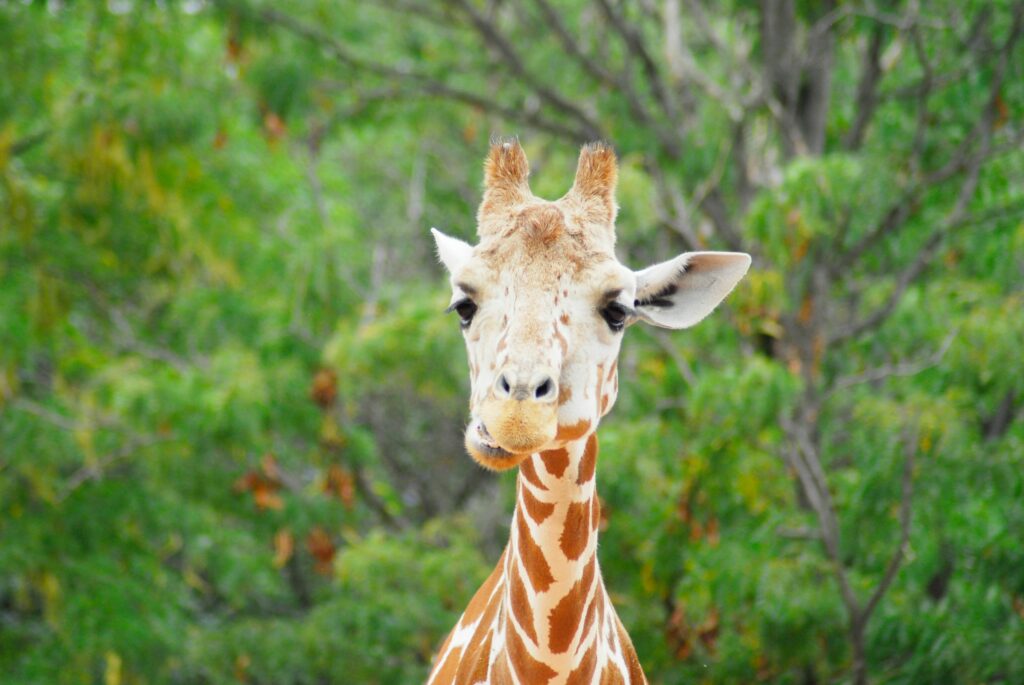
If you’ve ever seen a giraffe in person, you know they look like they were stretched out like silly putty. Their necks seem impossibly long. They’re long enough to peek into a second‑story window, or nibble leaves other animals can’t reach.
The real mystery is how giraffes wound up with such long necks to begin with.
It’s easy to imagine that giraffes stretched their necks higher and higher to reach leaves in trees, then they passed their long necks down to their babies. It’s a fun idea, but evolution doesn’t quite work like that.
The true story of how giraffes developed longer necks may just make you rethink what you know about these gentle giants. Giraffe evolution reveals just how important natural selection is in shaping species.
Today, we’re climbing into the world of ancient giraffes, fierce competition, and surprising adaptations to uncover how these gentle giants got their iconic necks.
A Tale of Two Theories
At first, scientists spent decades arguing over what really stretched the giraffe’s neck—was it hunger, or something far more dramatic? Finally, they settled on two possible theories.
1. The “Reaching for Leaves” Theory
This is the common explanation we’ve all probably heard at some point: giraffes with longer necks could reach higher leaves during droughts, giving them a survival advantage.
Over many generations, longer-necked giraffes survived and reproduced, leading to our modern giraffes’ extreme neck height.
This idea makes sense because giraffes eat from tall trees, like acacias.
2. The “Necking for Mates” Theory
The second theory revolves around fighting for mates.
Male giraffes fight by swinging their necks back and forth like a sledgehammer. This behavior is called necking.1
The males who had longer, heavier necks hit harder and would win more fights. The winner had the first pick for their desired mate.
This process is called sexual selection, or the tendency for traits to be more likely to attract mates.1
Today, most scientists agree that both feeding and fighting played roles in shaping giraffe neck evolution.1,2
The Ancient Giraffes: Not All Were Tall
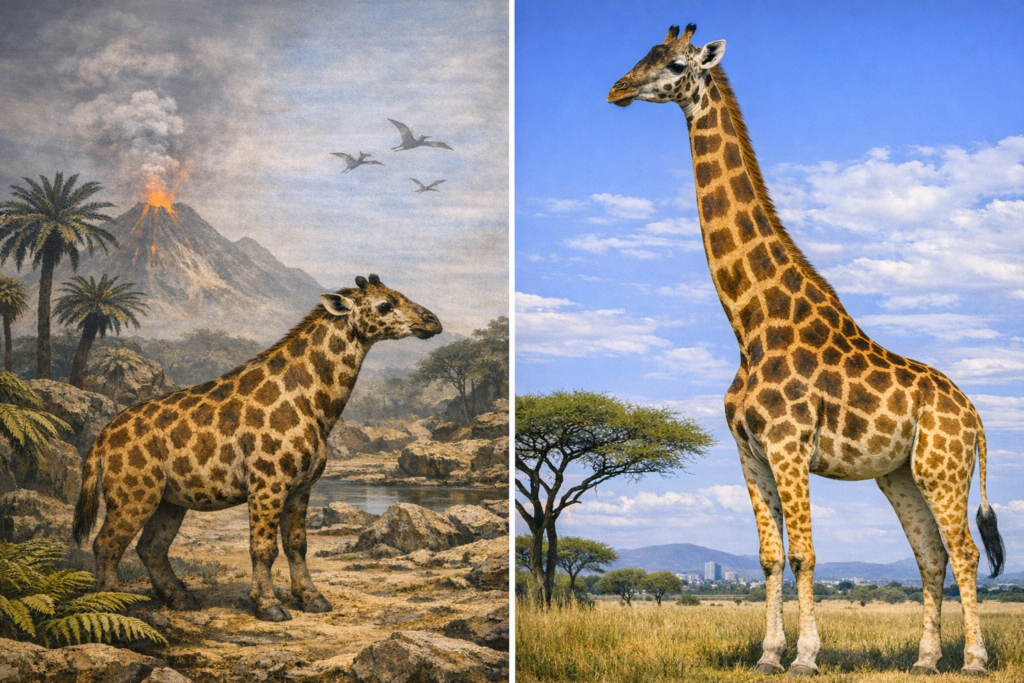
Believe it or not, modern giraffes didn’t actually start out as the tall beasts we see today. Their ancestors looked surprisingly different.
A fossil discovered by paleontologists in China painted a very different picture of ancient giraffes.3
This fossil is known as Discokeryx xiezhi. The giraffe relative had a short neck, but an incredibly strong skull and spine built for head-butting.3
With this information, scientists were able to determine something very important: neck evolution didn’t start with reaching for leaves.4,5
It started with competition.
Over millions of years, some giraffes evolved longer necks for fighting, while others evolved stronger skulls.
Stronger skulls were useful specifically for fighting. However, longer-necked giraffes had more survival advantages, such as reaching higher food sources during droughts.
Eventually, the longer neck was favored more by mates due to its versatile uses and led to the giraffes we see today.
The Puzzle of Seven Vertebrae
Here’s a fun fact you may not know: Almost all mammals — from mice to humans to giraffes — have exactly seven neck vertebrae. Why does this matter?
Well, you might think that with such long necks, giraffes must have more than seven vertebrae. But here’s the catch — they don’t. They still have only seven.
They didn’t add more bones. They simply stretched the ones they already had.
Each vertebra in a giraffe’s neck is enormous. Some of them are even over 10 inches long!
As giraffes evolved longer necks, their vertebrae lengthened as well. Those tiny shifts, repeated over many generations, built the giraffes we know today.
The Heart Problem: How Do You Pump Blood That High?
Though a long neck has its advantages for reaching high food and mating, it comes with a huge problem: how does blood reach the brain all the way up there?
Have you ever stood up a little too quickly before? Sometimes, standing up too fast suddenly pulls blood down towards your legs, causing your blood pressure to drop and then rise quickly. This results in a dizzy feeling.
This is the challenge that giraffes need to overcome head-on: how do they control their blood pressure? Here’s how they solved it with three remarkable adaptations.
1. A Super‑Powered Heart
A giraffe’s heart is massive and extremely muscular. It pumps blood at high pressure — about twice that of a human! This helps push the blood up to the brain.
2. Tight Skin and Specialized Valves
Their legs have tight skin that creates external pressure on their veins. They also have one-way valves that act like tiny doors. The valve can open to let blood move upward, but close to stop it from moving back down.
Both of these are useful to keep blood from pooling in the legs, especially when giraffes bend down to drink water.
3. A Pressure‑Control System
When a giraffe lowers its head, special blood vessels prevent the brain from getting flooded with too much blood. These vessels are super tiny. They slow down the flow of blood and assist with spreading pressure.
These adaptations didn’t appear all at once. They evolved step by step, alongside the neck.
This is a perfect example of co‑evolution — when multiple traits evolve together because they depend on each other.
Giraffes Today: Still Evolving
Evolution never stops. Giraffes today are still evolving.
Differences in neck length, body size, and coat patterns appear depending on where they live. Some populations have slightly shorter necks because they feed more on shrubs than tall trees.
This shows that giraffe evolution is still responding to the environment as it has for millions of years.
What Do Giraffe Necks Teach Us About Evolution?
Giraffe necks are the perfect example of how natural selection works to spread specialized traits.
Giraffe evolution started with a few giraffes developing longer necks. This trait provided advantages for feeding and mating, leading to the trait being passed to offspring.
The traits continued to develop, slowly adjusting to environmental demands. These small changes were added up to create today’s giraffes.
Evolution isn’t always a straight line or a perfect plan. It can take trial and error, shaped by patterns for survival, competition, and sometimes by plain chance.
A Last Look at the Long‑Necked Giants
Giraffes are living reminders of how powerful natural selection can be.
Their necks aren’t just long. They’re a result of millions of years of adaptation, competition, and survival.
Every part of a giraffe tells a story of ancient battles, demanding environments, and the slow but steady march of evolution.
Giraffes are living proof that evolution doesn’t rush to build masterpieces…and their story is far from over.
Evolution Activity, Definition Sheet, and Printable Article
Evolution Card Game
Student Trait Cards
Scenario Sets
Definition Sheet
Printable Article
Sources:
- Simmons, R. E., & Scheepers, L. (1996). Winning by a neck: Sexual selection in the evolution of giraffe. The American Naturalist, 148(5), 771–786.
- Mitchell, G., & van Sittert, S. J. (2021). Giraffe evolution: A review of sexual selection and feeding competition. Biological Reviews, 96(3), 1028–1044.
- Wang, S., et al. (2022). A Miocene giraffoid reveals origin of the giraffe’s long neck. Science, 376(6595), 1085–1090.
- Phys.org. . (2022). Strange fossil solves giraffe evolutionary mystery. https://phys.org/news/2022-06-strange-fossil-giraffe-evolutionary-mystery.html
- American Museum of Natural History. (2022). Ancient fossils show that head‑bashing combat contributed to the evolution of giraffes’ long necks.