
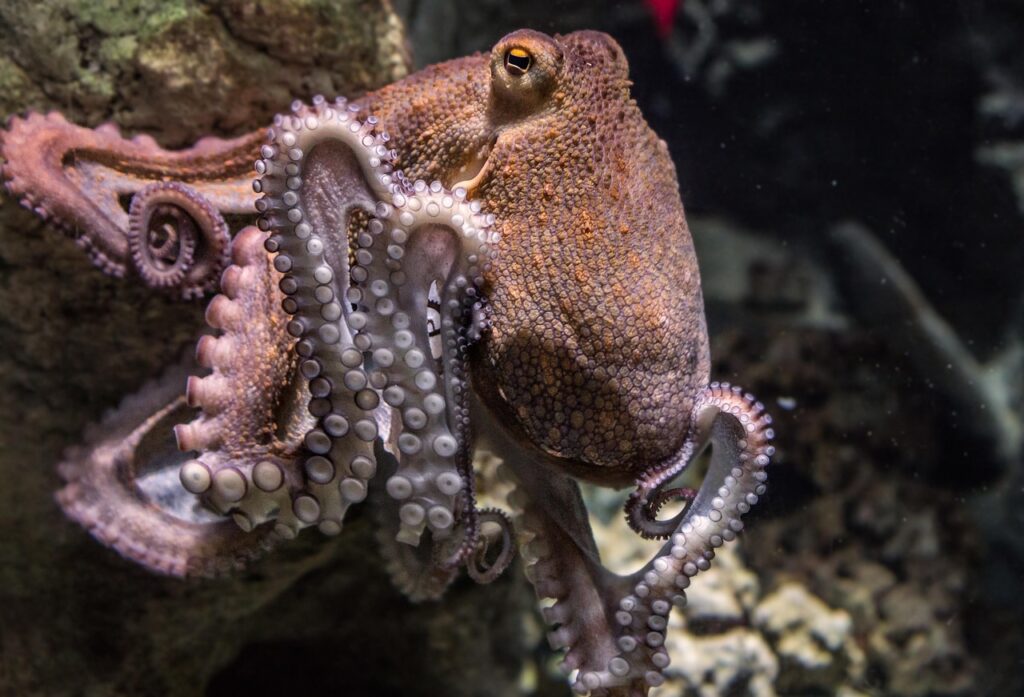
If you put your hand over your chest, you can feel a heartbeat from a single heart. Now, imagine what it would be like to feel three beating hearts – all at the same time.
That’s exactly how many hearts an octopus has, and these clever cephalopods need all three to survive. Living in the ocean can be tough, but an octopus’s body is built in a way to handle the challenges of the deep blue sea.
So why does an octopus have three hearts? Let’s dive into the “heart” of what makes them so unique.
Where Are an Octopus’s Hearts?
When you think about where a heart should be, you would generally believe it should be located in the chest. However, all three of an octopus’s hearts are actually located in its head.1
In fact, almost all of an octopus’s organs, like the hearts, gills, and stomach, are located in the head. These organs are protected by a muscular sac called the mantle.
However, the mantle has much more to offer besides protection. It helps the octopus to breathe, move, and even change color.
When an octopus breathes, it pulls water into its mantle. As the water flows over the gills, tiny blood vessels absorb oxygen from the water. When the octopus wants to move fast, the mantle can squeeze that water out, helping the octopus shoot forward like a rocket.
Pretty cool, right?
Meet the Three Hearts
Now, let’s talk about what you’re here for – the hearts.
Not all three of the octopus’s hearts perform the same role. There are actually two types of hearts: branchial hearts and a systemic heart.1
The branchial hearts are responsible for pumping blood into the gills, with one heart for each gill. As we mentioned earlier, when the water passes over the gills, oxygen is absorbed into the bloodstream and then carried off to the systemic heart.
Once the blood is oxygenated, the systemic heart becomes solely responsible for distributing the blood to the entire body. This includes sending blood to its arms, muscles, and brain.
Teamwork between the two branchial hearts and the systemic heart keeps oxygen pumping through the octopus.
Doesn’t this seem like an efficient system?
Well…it’s not. Not exactly, anyway.
Why Three Hearts Still Aren’t Enough
Even with three hearts working together, an octopus’s circulatory system still requires extra effort to carry oxygen throughout the body. Why? The reason comes down to the type of blood octopuses have. Bear with me here. This is where things can get a little complicated.
Unlike humans, who use a protein called hemoglobin to carry oxygen in our blood, octopuses use hemocyanin.2
Hemoglobin uses iron to transport oxygen, and each hemoglobin molecule can carry up to four oxygen molecules.2
On the other hand, hemocyanin uses copper to carry oxygen, which can only carry one molecule at a time. This means that even with three hearts, an octopus still can’t pump blood as efficiently as a single human heart.2
In addition to the lower oxygen transportation, the copper in hemocyanin also gives the signature blue color to an octopus’s blood. Once oxygen hits the blood, it turns blue.2
Why Use Blue Blood at All?
Knowing that hemocyanin is less efficient than hemoglobin, you might be wondering: why do they have that type of blood then?
The answer to that has to do with the marine environment.
From the surface, the ocean may seem calm on days when there is a gentle breeze, but underneath, the ocean isn’t calm at all. Marine life below the surface must constantly adapt to changes in temperature, pressure, and varying oxygen levels. This is especially true for deeper, colder areas of the ocean.3
A body unable to adapt to these conditions would succumb to stress.
But that’s where hemocyanin comes in. It can handle these changes better than hemoglobin does. Hemocyanin helps maintain stable blood pressure as environmental conditions change.3 This makes it a better choice for life underwater, even if it isn’t the quickest way to move oxygen throughout the body.
Simply put, an octopus’s blood and hearts are built to be reliable, not quick.
The Problem with Swimming Fast
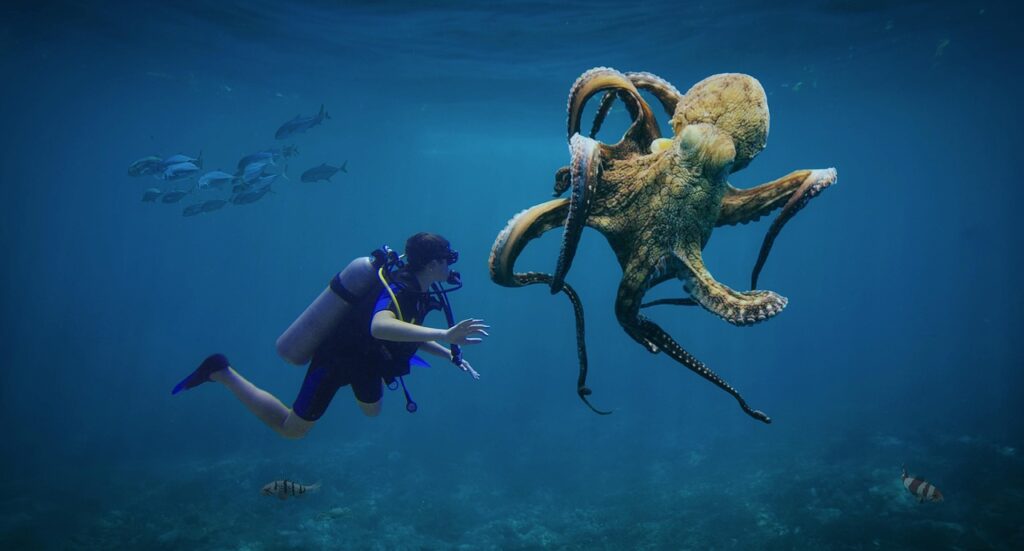
Do you recall when we spoke about how the mantle pushes water out of itself to help an octopus move?
That system is called jet propulsion. The water is pulled into the mantle, then forcefully pushed out of the tube-like body part called the siphon. This pushes the octopus forward in the water.1
To see how this works, blow up a balloon and release it when it’s full of air. The air pushing back out of the hole makes the balloon fly. That’s how jet propulsion works for an octopus.
Unfortunately, there is a downside to this speedy movement.
When an octopus uses jet propulsion to swim, pressure inside the mantle increases. The pressure increase makes it incredibly difficult for an octopus to pump blood through the body.2
So, when an octopus swims, the systemic heart (the one responsible for transporting blood to the entire body) temporarily stops beating.2
This doesn’t hurt the octopus, but it can interrupt their breathing. This is because the water that is used to absorb oxygen from the gills is the same water that is pushed out to propel the octopus. This limits the octopus’s access to oxygen.
You might be thinking, is that why you often see octopuses crawling?
You would be absolutely correct.
Swimming is a tiring task for an octopus because it makes breathing more difficult, so you will often see octopuses crawling along the ocean floor instead of swimming.
Crawling allows them to continue to use all three hearts, breathe properly, and conserve energy. It may seem like a slow way to move, but for an octopus, it’s the smart way.
A Little Fun Fact Before Departing
Octopuses are an incredibly intelligent species. They can solve puzzles, learn to open containers, and are known as tank escape artists.
But what does the brain need to accomplish all of that? Oxygen!
The cool part? Octopuses have more than one brain. In fact, each of their arms has its own mini brain that can move and react independently.4 This is another reason it’s so important to have three hearts that can keep the body going.
The system isn’t perfect, but it’s just what an octopus needs.
So… Why Three Hearts?
While there is plenty more to love about octopuses, like their ability to change colors, their heart will always have a unique place within biology.
From the mantle that holds all three hearts to the blue blood that the heart pumps throughout the body, an octopus’s design is meant to overcome the challenges of living in a harsh marine environment.
Octopuses may seem strange, or even fascinating to some people, but every part of their body is uniquely designed for the environment in which they live.
Sometimes, nature’s weirdest designs turn out to be the most brilliant.
Worksheet & Answer Key, Definition Sheet, and Printable Article
Worksheet and Answer Key
Definition Sheet
Printable Article
Sources
1. IRIS Catalogo Ricerca UniNA. (2024/2025). Oxygen-supply and in vitro performance of the systemic heart of Octopus vulgaris: Effects of hemocyanin. University of Naples Research Archive.
2. Davies, J. G., Platts, J. A., Young, M. T., & Menzies, G. E. (2025). Increased functional unit flexibility and solvent accessibility favour oxygen capture in molluscan hemocyanin. RSC Advances, 15, 20373–20384.
3. Oellermann, M., Strugnell, J. M., Lieb, B., & Mark, F. C. (2025). Positive selection in octopus hemocyanin indicates functional links to temperature adaptation. Marine Genomics.
4. Biology Insights. (2025). Do octopus bleed? The science of their blue blood & three hearts. Biology Insights Magazine.